- Herbspace
- Fri,10 2026
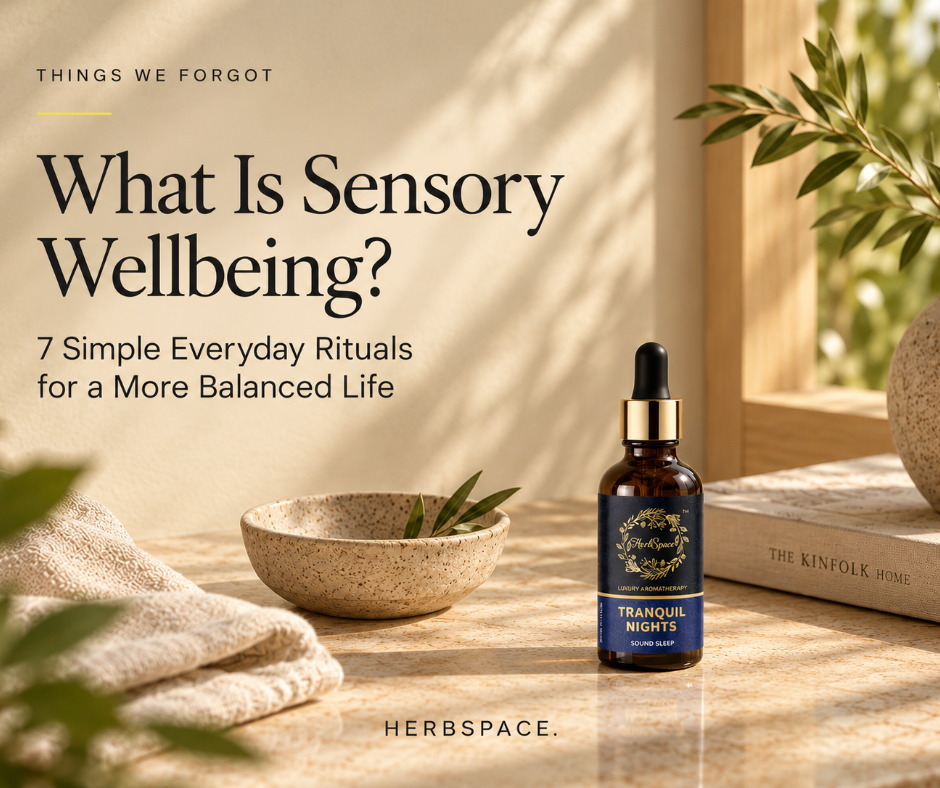
What Is Sensory Wellbeing? 7 Simple Everyday Rituals for a More Balanced Life
We spend much of our lives trying to do more, become better, respond faster and keep up.
In the middle of it all, the simplest things can begin to feel optional. Rest becomes something we earn after finishing our work. A pause feels unproductive. Caring for ourselves becomes another item on an already crowded to-do list.
But what if wellbeing didn't have to be another thing to accomplish?
What if it could begin with something much smaller — a familiar fragrance, a few quiet minutes, a moment of movement or a simple ritual that helps us return to the present?
At HerbSpace, we call this sensory wellbeing: making space for thoughtful sensory experiences that become part of everyday life.
Our series, Things We Forgot, began with a simple idea: perhaps we don't always need to learn something new. Sometimes, we need to remember what matters.
Here are seven reminders worth returning to.
What Is Sensory Wellbeing?
Sensory wellbeing is an approach to everyday wellbeing that pays attention to how we experience the world through our senses — smell, touch, sight, sound and the physical sensations of our surroundings.
The fragrance of a familiar essential oil. The texture of a nourishing face oil. The warmth of a morning shower. The quiet of a room before the day begins.
These experiences may seem small, but they can give ordinary moments a greater sense of intention.
Fragrance, in particular, has a close relationship with memory and emotion. A familiar scent can evoke a place, a person or a moment. When we pair a sensory experience with a repeatable habit, it can become a personal cue to pause, settle into a routine or pay attention to ourselves.
Sensory wellbeing is not about achieving a perfect state of calm. Nor is it a substitute for appropriate medical care.
It is about making everyday life feel a little more considered — one small experience at a time.
1. Rest Doesn't Have to Be Earned
Somewhere along the way, rest became a reward.
We tell ourselves we'll slow down after finishing the work, answering the messages, looking after everyone else and completing everything on the list.
But the list rarely ends.
Rest is not a prize for productivity. It is a necessary part of living, and it deserves a place in our routines before exhaustion demands it.
A ritual to try: Create a simple evening routine. Dim the lights, put away your phone for a few minutes, and choose a familiar cue that signals the transition from a busy day to a quieter evening. It might be a few pages of a book, a gentle stretch or a fragrance you associate with bedtime.
The ritual doesn't have to be elaborate. It simply needs to be repeatable.
Things We Forgot #1 — Rest.
2. Your Body Keeps Score
We often notice our bodies only when they ask for attention.
A stiff back after sitting too long. Tired shoulders after a demanding day. Muscles that remind us we've been pushing through without enough recovery.
Our bodies are part of our everyday experiences, not separate from them.
Paying attention to physical comfort can help us recognise when a small change in our routine is needed. Sometimes that means getting up from the desk, taking a short walk, stretching gently or allowing time for a body-care ritual.
A ritual to try: At the end of a long day, take a few minutes to notice where you are holding tension. Move gently, change your position or massage a suitable body oil into your hands or shoulders as part of your personal care routine.
The intention isn't to ignore discomfort or promise a quick fix. It is to become more attentive to the body you live in every day.
Things We Forgot #2 — Recovery.
3. Not Everything Needs an Immediate Response
Messages arrive. Notifications compete for attention. Questions demand answers. Even our quiet moments can become filled with the feeling that we should be doing something else.
Over time, constant responsiveness can leave very little room to notice how we feel.
A pause creates a little space between what happens and how we respond. It doesn't need to be long to be meaningful.
A ritual to try: Before moving from one task to the next, take three slow, comfortable breaths. Notice the feeling of your feet on the floor. Let your shoulders soften. If you enjoy fragrance, choose a familiar scent as a reminder to return your attention to the present.
You don't need to turn every pause into a productivity technique. Some moments can simply be moments.
Things We Forgot #3 — Pause.
4. Your Body Isn't a Machine
We often expect ourselves to operate at the same pace every day.
The same energy. The same concentration. The same capacity to manage work, relationships and responsibilities.
But people aren't machines. Our needs can change with our circumstances, routines, sleep, stress and health.
For many women, paying attention to their menstrual cycle can also be one way of becoming more aware of changing needs. This doesn't mean every experience can be explained by a cycle, or that everyone will notice the same patterns.
It means allowing room to observe rather than judging ourselves against a fixed expectation.
A ritual to try: Take a few minutes to check in with yourself. How are your energy and comfort today? Would gentle movement, a quieter evening or a little more rest feel appropriate? Keep the routine simple and adapt it to your needs.
If pain or other symptoms are persistent, severe or concerning, seek advice from a qualified healthcare professional rather than relying on a self-care ritual alone.
Things We Forgot #4 — Rhythm.
5. Movement Isn't a Workout
We tend to associate movement with exercise plans, step counts, gym sessions and measurable goals.
Those things can be useful, but movement can also be much simpler.
Walking to the window. Stretching between meetings. Taking the stairs when appropriate. Standing up after a long period at a desk. Moving gently while waiting for the kettle to boil.
Not every movement needs to be part of a fitness plan.
A ritual to try: Choose one natural pause in your day and use it to move. Stretch your arms, walk around the room or take a short stroll outside. If you spend long periods sitting or standing, make comfortable changes in position when you can.
Small opportunities for movement can make everyday routines feel less static. And when your day has been demanding, caring for tired legs can be as simple as putting your feet up and taking a few moments to rest.
Things We Forgot #5 — Movement.
6. Caring for Yourself Was Never Vanity
Self-care is sometimes presented as an indulgence — something extra to do when there is time, money or energy to spare.
But caring for yourself can also be an ordinary act of attention.
Washing your face without rushing. Applying a face oil as part of your skincare routine. Combing your hair slowly. Taking a moment to notice the texture of a product rather than treating the experience as another task to finish.
The difference is not necessarily in what you use. It is in how you make room for the experience.
A ritual to try: Simplify your evening skincare routine. Cleanse your face, apply products suited to your skin and take a moment to massage them in gently. Choose a routine you can maintain comfortably, rather than one that requires constant additions.
Self-care doesn't have to be elaborate to be worthwhile.
Things We Forgot #6 — Nourishment.
7. Growth Has Always Taken Time
We live in a world that rewards immediacy.
Quick results. Instant answers. Visible progress.
But some of the things that matter most develop quietly. Confidence, meaningful relationships, useful habits, professional skills and the condition of our hair all involve processes that cannot always be rushed.
Hair care is a useful reminder. One application of oil or one change in routine cannot guarantee a particular result. Hair has its own growth cycle, and its condition is influenced by many factors, including genetics, health and how it is cared for.
A thoughtful hair-care routine is less about chasing overnight transformation and more about consistency, gentle handling and patience.
A ritual to try: Choose a manageable hair-care routine that suits your needs. Brush gently, use appropriate products and make time for scalp care if it feels comfortable. Give the routine time to become familiar instead of repeatedly changing everything in search of instant results.
The same principle applies beyond hair care. Sometimes progress is happening before it becomes visible.
Things We Forgot #7 — Restoration.
How to Build a Sensory Wellbeing Ritual That Lasts
A meaningful ritual doesn't need a complicated schedule or a shelf full of products. It should fit into the life you already have.
Start with these four steps:
1. Choose one moment.
Begin with something you already do, such as getting ready in the morning, taking a break from work or preparing for bed.
2. Add one sensory cue.
This might be a familiar fragrance, a comforting texture, soft lighting, a favourite piece of music or a cup of tea.
3. Keep it simple.
A ritual that takes a few minutes and fits naturally into your day is often easier to maintain than an elaborate routine.
4. Let it be personal.
There is no single correct way to practise wellbeing. What feels meaningful to one person may not suit another. Pay attention to what works for you and adjust when your needs change.
If you use essential oils, follow the product's directions and appropriate dilution and safety guidance. Essential oils are concentrated substances, and natural does not automatically mean suitable for everyone.
The aim is not to create another standard to meet. It is to find a small practice that feels right for you.
Where HerbSpace Fits In
HerbSpace is India's sensory wellbeing brand, built around the idea that everyday care can be thoughtful, approachable and personal.
Our products are designed to become part of familiar routines — from winding down at the end of the day to caring for your body, skin or hair.
We believe in understanding before advising. We believe in honest communication about what products can and cannot do. And we believe that wellbeing should feel like an invitation, not an obligation.
A fragrance can become a familiar part of an evening routine. A body oil can accompany a few minutes of massage. A hair oil can turn an ordinary task into a moment of care.
The product is only one part of the experience. The ritual is what you make of it.
Explore the HerbSpace collection to discover products that may fit into your everyday rituals.
Things We Forgot: Seven Reminders to Return to Ourselves
We began this series with seven reminders:
- Rest doesn't have to be earned.
- Your body keeps score.
- Not everything needs an immediate response.
- Your body isn't a machine.
- Movement isn't a workout.
- Caring for yourself was never vanity.
- Growth has always taken time.
None of these ideas requires us to change our lives overnight.
Perhaps we can begin by making one moment less rushed. By paying attention to a need we have been ignoring. By allowing a simple habit to become familiar.
Wellbeing doesn't always need to be complicated. Sometimes, it begins with a small, thoughtful ritual.
HerbSpace — India's sensory wellbeing brand.
Make room for a little more wellbeing.
Featured
-

Add a few drops of your favorite essential oil into your Shampoo or face wash and enjoy the benefits of aromatherapy” Easy peachy right? Well, not really!!! Before you roll your eyes and go “What are you talking
Read More... -

Add a few drops of your favorite essential oil into your Shampoo or face wash and enjoy the benefits of aromatherapy” Easy peasy right? Well, not really!!! Before you roll your eyes and go “What are you talking
Read More... -

In this blog series, we will learn all the important aspects related to essential oils. Let's start with what essential oil, concrete, resinoid, and absolute
Read More... -

Over the past few years, the market for essential oils has significantly grown. And, they are going to be the next big thing in the future. Essential oils undoubtedly have some unbeatable therapeutic properties that
Read More...